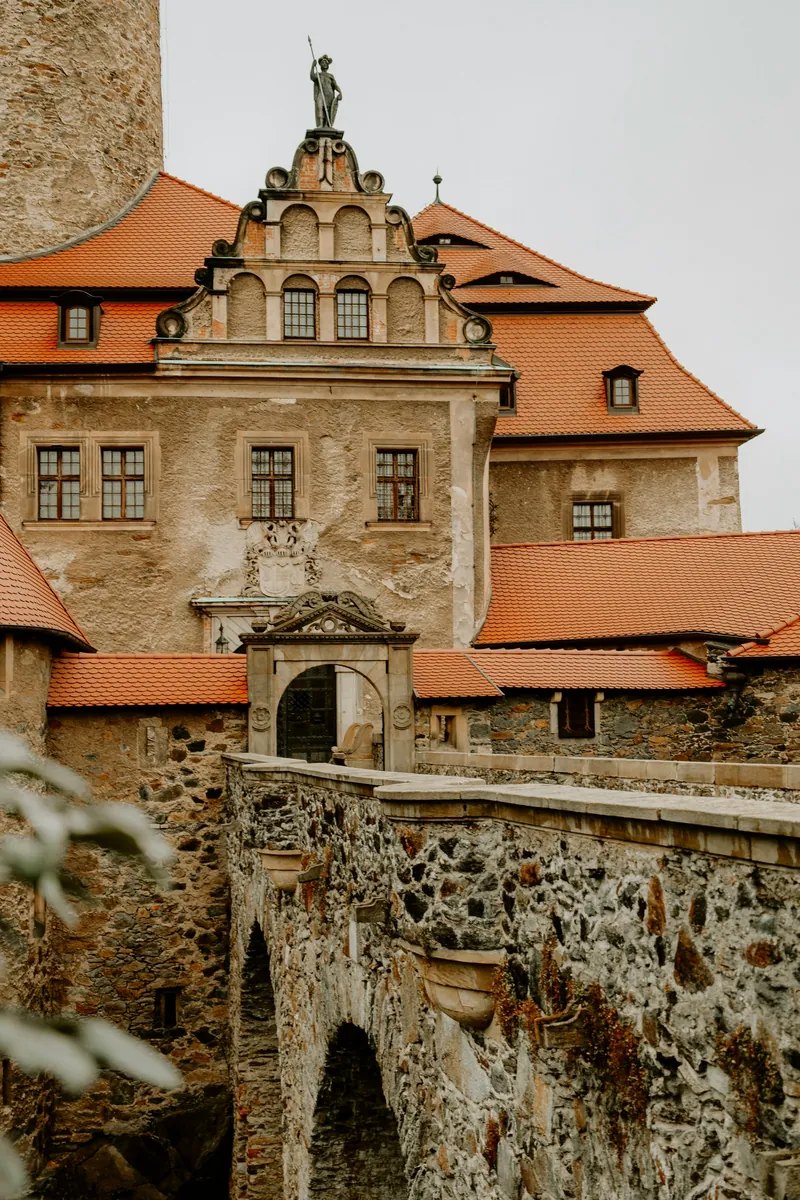
Czocha Castle (Zamek Czocha) began in the mid-13th century, when construction was ordered by Wenceslaus I of Bohemia around 1241–1247 on a spur of hard gneiss rock above the Kwisa river. Its oldest surviving element is the keep, the tall round tower at the castle's heart, around which walls, halls and courtyards grew over the following centuries.
The castle passed through the von Dohna and von Kluks families between 1389 and 1453, then to the Nostitz family, who bought it in 1453 and held it for roughly 250 years, remodelling it in 1525 and again in 1611. On 17 August 1793 a fire destroyed much of the complex, and for over a century Czocha stood only partly repaired.
In 1909 the Dresden cigar manufacturer Ernst Gutschow bought Czocha and commissioned the Berlin architect Bodo Ebhardt to rebuild it. Working through the 1910s and guided by a 1703 painting of the castle, Ebhardt gave Czocha the romantic, storybook silhouette — turrets, drawbridge and battlements — that visitors photograph today. After 1952 the Polish Army took it over as a military resort and the castle was quietly erased from official maps.
Since September 1996 Czocha has been open to the public as a hotel, conference centre and visitor attraction. The guided tour of the halls — Knight's Hall, Marble Hall, Library Hall, Portrait Hall and the Prince's Chamber — threads past historic wall paintings, renovation discoveries and a display of Polish People's Republic-era military communication devices, before climbing to the lookout tower for a view over the Kwisa river and the forests, at their most spectacular in autumn. Secret passages and hidden rooms, its many film roles and the College of Wizardry live-action role-play have made Czocha one of the most atmospheric castles in Poland.